
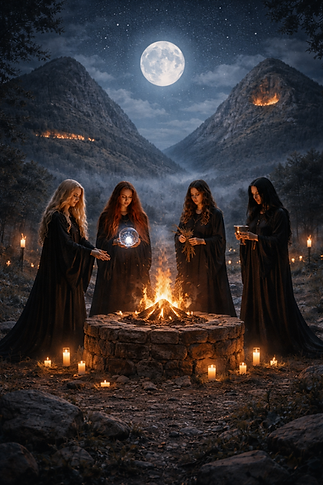
The Circle of the Crone & The Bloodroot Sisters
The Circle of the Crone began long before it had a name~born from the women who survived when others didn’t, the ones who learned to read the moon, the bones, and the earth itself. Across continents and centuries, these midwives, healers, and death‑keepers slowly recognized one another through shared rites: blood that marked transitions, herbs that bent fate, and the belief that the moon was the oldest witness to all things buried. As their scattered practices converged, the Crone emerged as a unifying figure~an ancient, many‑faced deity of endings, memory, and transformation. By the time patriarchal blood‑priests attempted to seize their power, the Circle had already become a global, clandestine network capable of defending itself and preserving its mysteries.


When a small sect of witches fled persecution and followed early migration routes into the Americas, they felt something stirring beneath the San Juan mountains ~ an ancient consciousness, wounded or dreaming, that resonated with the Crone’s darker face. In the shadow of Opaline Peak, European witches, a scattering of male Brujah, Indigenous medicine women, and escaped enslaved herbalists both men and women found one another and recognized the same lunar pull. Their traditions braided together into a new lineage rooted in the land itself. They named themselves the Bloodroot Sisters, after the plant that stains the skin red and grows only where the mountain’s influence is strongest. Their oath was simple and absolute: guard the Peak, guard the Buried God, and guard the balance between all supernatural forces drawn to its power.
Over the centuries, the Bloodroot Sisters became the Circle’s Appalachian anchor~negotiating with Blood Marked and Garou, sabotaging corrupted cults, and shaping Opaline’s fate from the shadows. They survived industrial expansion, hidden wars, and the rise and fall of rival factions by blending into the town they protected. By the 21st century, they were school nurses, midwives, librarians, and quiet women with moon‑marked eyes who knew far more than they ever said. As the Buried God stirs again and supernatural tensions sharpen, the Sisters stand as the last, one of the oldest lines of defense~ the keepers of rites older than the town, older than the Peak, and older than the first name ever whispered for the Crone
Origins
Prehistory ~ The First Crone
• Long before written language, women who survived childbirth, famine, winter, and war became living repositories of knowledge.
• These early survivors~midwives, bone‑readers, moon‑watchers~began to share a single belief: the moon is the oldest witness, and the earth remembers everything buried in it.
• Their rites were simple: blood, breath, and bone. This proto‑sisterhood becomes the First Circle, though they had no name for themselves yet.
~3000–1500 BCE ~ The Old World Convergence
• Across Europe and the Near East, isolated moon‑cults begin exchanging rites through wandering herbalists and midwives.
• A shared pantheon emerges: the Crone, the final face of the moon, keeper of endings, memory, and transformation.
• Blood‑magic becomes formalized: menstrual blood, birthing blood, and the blood of sacrifice each hold different lunar resonances.
• The Circle becomes a network, not a tribe.
~800–400 BCE ~ The First Schism
• A faction of blood‑priests (mostly men) attempt to weaponize the Crone’s rites for political power.
• The Circle rejects them violently.
~900–1200 CE ~ The Appalachian Thread Begins
• A small sect of Crone‑devotees flees persecution in Europe and follows Norse and Celtic migration routes into the early Americas.
• They settle in the Appalachian mountains, drawn by a presence they can feel in the land: a sleeping, ancient consciousness beneath the stone.
• They call it the Buried One, believing it to be an avatar or wound of the Crone herself.
1600s ~ The Bloodroot Sisters Form
• European witches, Indigenous medicine women, and escaped enslaved herbalists begin exchanging knowledge in the shadow of Opaline Peak.
• Their combined traditions~lunar rites, rootwork, bone‑casting, and mountain‑spirit veneration~fuse into a new lineage.
• They take the name The Bloodroot Sisters, after the plant that stains the skin red and grows only where the mountain’s influence is strongest.
• They swear a generational oath:
Guard the Peak. Guard the Buried God. Guard the balance.
1700s ~ The Mountain Chooses
• The Circle’s global network recognizes Opaline as a locus, a place where the Crone’s power pools unnaturally deep.
• The Bloodroot Sisters become the Circle’s Appalachian anchor‑coven.
1800s ~ The Blood Marked & Garou Arrive
• Vampires or the Blood Marked and werewolves (Garou) sense the mountain’s power and begin migrating toward Opaline.
• Both factions attempt to court the Bloodroot Sisters.
• The Sisters refuse to be claimed, but they learn to negotiate, manipulate, and~when necessary~curse.
• A fragile, uneasy triangle of influence forms.
Late 1800s ~ The Crimson Dawn Emerges
• A splinter group of mystics and zealots, obsessed with the mountain’s buried power, resurrect fragments of the old corrupted rites.
• This becomes the Crimson Dawn, precursor to the modern Cult of Seth.
• The Bloodroot Sisters sabotage their rituals repeatedly, preventing several near‑catastrophes.
1900–1950 ~ The Quiet War
• The Sisters fight a hidden war against industrialists, miners, and cultists who try to dig too deep into Opaline Peak.
• Several mines collapse under “mysterious circumstances.”
• The Circle’s global network sends reinforcements, recognizing the threat.
1960–1990 ~ The Veiling
• The Bloodroot Sisters adopt a new strategy:
Blend in. Become the town. Hide in plain sight.
• They become midwives, herbalists, school nurses, librarians, and eccentric recluses.
• Their rituals move deeper into the mountain’s groves and ruins.
2010–2020 ~ The Cult of Seth Rises Again
• The Crimson Dawn reforms under new leadership, claiming to have rediscovered “the original rites.”
• The Sisters recognize the danger immediately:
They are repeating the mistakes of the First Schism.
• Infiltration, sabotage, and counter‑rituals become routine.
2020–2026 ~ The Present Veil
• The Circle’s global network is fractured, but the Bloodroot Sisters remain strong.
• Blood Marked and Garou tensions escalate, each seeking the Sisters’ allegiance.
• The Buried God’s dreams bleed into the waking world.
• The Sisters stand at the center of Opaline’s supernatural politics, the last line between balance and catastrophe.